
- ChatGPT - Home
- ChatGPT - Fundamentals
- ChatGPT - Getting Started
- ChatGPT - How It Works
- ChatGPT - Prompts
- ChatGPT - Competitors
- ChatGPT - For Content Creation
- ChatGPT - For Marketing
- ChatGPT - For Job Seekers
- ChatGPT - For Code Writing
- ChatGPT - For SEO
- ChatGPT - For Business
- ChatGPT - Machine Learning
- ChatGPT - Generative AI
- ChatGPT - Build a Chatbot
- ChatGPT - Plugin
- ChatGPT - GPT-4o (Omni)
- ChatGPT in Excel
- ChatGPT for Test Automation
- ChatGPT on Android
- Make Money with ChatGPT
- ChatGPT for UI/UX Designers
- ChatGPT for Web Developers
- ChatGPT for Data Scientists
- ChatGPT for Bloggers
- ChatGPT for Personal Finance Management
- Automate Customer Support with ChatGPT
- Create Content Calendars with ChatGPT
- Plan Events and Trips with ChatGPT
- Draft Legal Documents with ChatGPT
- Improve Your Coding Skills with ChatGPT
- New Language with ChatGPT
- Optimize ChatGPT Responses for Better Accuracy
- ChatGPT Useful Resources
- ChatGPT - Quick Guide
- ChatGPT - Useful Resources
- ChatGPT - Discussion

ChatGPT Tutorial
What is ChatGPT?
ChatGPT, short for Chat Generative Pre-trained Transformer, is a conversational AI system developed by OpenAI, a leading artificial intelligence research company. ChatGPT facilitates natural conversations between humans and the bot.
ChatGPT is built on top of OpenAIs foundational large language models (LLMs) like GPT-4 (Generative Pre-trained Transformer) and its predecessors. It uses advanced natural language processing (NLP) algorithms to generate human-like responses to user inputs and can hold conversations on a wide range of topics.
A Simple Interaction with ChatGPT
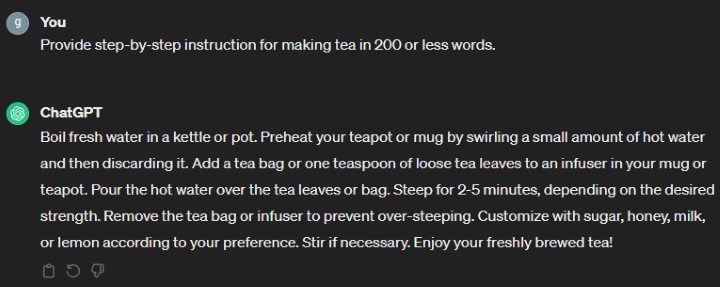
Lets have a look at a simple interaction with ChatGPT. Here, we are seeking a step-by-step set of instructions on how to prepare tea −
How Did ChatGPT Come into Existence?
OpenAI, a company with a San Francisco-based AI research lab, developed ChatGPT. The 30th of November 2022 marked a significant milestone as OpenAI unveiled the web preview of ChatGPT, opening its virtual doors to the public.Since it first came out, OpenAI has been working hard to make ChatGPT even better. They started with a Pro version using the powerful GPT-4 model. After that, they added features like web browsing and creating images with Dall-E. Now, ChatGPT is not just for chatting; it can do much more, for example, looking at the web and making pictures.
Why ChatGPT Got Everyone's Attention?
ChatGPT got everyones attention due to its impressive language generation capabilities and potential uses in various industries and applications.
ChatGPT can assist users in code writing, content creation, marketing, SEO, customer service, language translation and many other fields.
Its widespread adoption is attributed to its user-friendly interface and its ability to generate coherent and contextually relevant responses.
Can ChatGPT Understand Context in a Conversation?
Yes, ChatGPT is designed to understand and respond to the context of a conversation. Its neural network is trained on a wide range of text data, allowing it to generate coherent and relevant responses based on the context of the conversation.
This valulable feature enhances the ability of ChatGPT to engage in meaningful and continuous discussions with users.
Is ChatGPT Free to Use?
Yes, the basic version of ChatGPT is free to use. However, there is also a subscription plan for individuals and businesses, offering additional benefits like faster response times and priority access to new features.
The subscription option offers an extra layer of convenience for users seeking an elevated and efficient interaction with the language model. You can check the pricing at OpenAIs pricing page.
Audience
This ChatGPT tutorial can benefit a diverse audience, including −
General Users − Those looking to explore and utilize ChatGPT for various purposes, such as content creation, brainstorming, job seeking, or casual conversation.
Developers − Individuals interested in integrating ChatGPT into applications or websites, understanding the basics of API usage, and exploring potential use cases.
Businesses − Companies seeking to leverage ChatGPT for customer support, content generation, SEO, marketing, or other applications within their operations.
Students/Researchers − Those in academic settings interested in experimenting with language models and natural language processing.
Prerequisites
To use and understand ChatGPT, the reader should have −
Basic Computer Skills − The reader should be familiar with using a computer and a web browser.
Internet Connection − To interact with ChatGPT on the OpenAI platform, you should have access to the internet.
Interest in Natural Language Processing (NLP) − Although it is not mandatory but having a curiosity about how language models work, and their applications will enhance the readers understanding.
Python Programming Knowledge (Optional) − If you plan to explore the OpenAI API or more advanced use cases, some understanding with python programming would be helpful.
We have designed this ChatGPT tutorial to be accessible to a broad audience, including those without any extensive technical background.
FAQs
Yes, using ChatGPT can be beneficial for various tasks such as content generation, language understanding, marketing, SEO, customer service, and assistance with a wide range of queries.
ChatGPT is versatile and user-friendly, making it a valuable tool for individuals and businesses. Whether you seek information about job, creative input, or need programming help, ChatGPT can enhance your overall experience with natural language interaction.
You can rely on ChatGPT for better research or understanding of concepts. However, you need to verify the content provided by the ChatGPT from a viable source.
ChatGPT is an AI chatbot that you can engage in a human-like conversation. The bot uses Natural Language Processing to understand a query and respond in a way that doesnt sound like a robot.
There are several alternative chatbots to ChatGPT. You can explore Google Gemini (known as Bard earlier), Jasper Chat, Claude, LaMDA, Chatsonic, Bing AI, DialoGPT, and more.
Yes, you can use ChatGPT for commercial purposes. In fact, OpenAI encourages businesses to explore and integrate ChatGPT into their applications, products, or services. However, please note that you need to comply with any applicable laws and regulations related to the use of AI technology in your specific industry or location.
For more information, you can refer to the OpenAI content policy and terms
ChatGPT can be a great assistant to boost productivity in your business. It can help developers beautify their code, break down bigger projects, create content, lead generation, improve customer support, and more.
No, there is no limit to the length of input prompts for ChatGPT. But it is still recommended to keep them concise for a better response.
However, ChatGPT has a limitation of generating responses within a specific character limit. Extremely long prompts may result in shorter or incomplete responses from ChatGPT.
Yes, you can fine-tune ChatGPT to perform specific tasks or cater to specialized industries.
The process of fine-tuning ChatGPT involves taking a pre-trained model such as GPT-3. Fine-tuning enhances the models performance and makes it more useful for applications.