- Business Analytics - Home
- Business Analytics Basics
- Business Analytics - What It Is?
- Business Analytics - History and Evolution
- Business Analytics - Key Concepts and Terminologies
- Business Analytics - Types of Data
- Business Analytics - Data Collection Methods
- Different Tools used for Data Cleaning
- Business Analytics - Data Cleaning Process
- Different Sources of Data for Data Analysis
- Business Analytics - Data Cleaning
- Business Analytics - Data Quality
- Descriptive Analytics
- Descriptive Analytics - Introduction
- How Does Descriptive Analytics Work?
- Descriptive Analytics - Challenges and Future in Data Analysis
- Descriptive Analytics Process
- Descriptive Analytics - Advantages and Disadvantages
- Descriptive Analytics - Applications
- Descriptive Analytics - Tools
- Descriptive Analytics - Data Visualization
- Descriptive Analytics - Importance of Data Visualization
- Descriptive Analytics - Data Visualization Techniques
- Descriptive Analytics - Data Visualization Tools
- Predictive Analytics
- Predictive Analytics - Introduction
- Statistical Methods & Machine Learning Techniques
- Prescriptive Analytics
- Prescriptive Analytics - Introduction
- Prescriptive Analytics - Optimization Techniques
Business Analytics Tutorial
Business Analytics Tutorial
Before understanding Business Analytics; let’s understand the term analytics first.
Analytics refers to analysing collected organisations' data to find business insights and predictions. The results of data analytics are used by the business authorities to frame potential business strategies and make fruitful decisions to grow the business.
What is Business Analytics?
The term business analytics also referred to as business data analytics is a process of analysing historical business data using statistical methods and computing technologies to find out business trends, data patterns, correlations and root causes that enable business organisations to frame data-driven decision-making.
Business analytics involves companies that use data created by their operations or publicly available data to solve business problems, monitor their business fundamentals, identify new growth opportunities, and better serve their customers.
Business analytics uses data exploration, data visualization, integrated dashboards, and more to provide users with access to actionable data and business insights.
Process of Business Data Analytics
The process of business data analytics involves some set of steps; these are as follows −
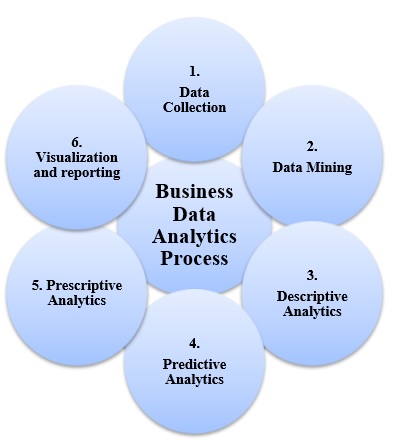
- Data collection − Data collection: Business data is collected from organisations' internal departments and external boundaries like IoT devices, apps, spreadsheets, or social media. The collected data is pooled and centralized for access and processing as and when required.
- Data mining − Collected data stored in Data Lake and then processed using advanced tools and techniques like Machine learning algorithms, data visualisation techniques, statistical methods etc.
- Descriptive analytics − Descriptive analytics answers like what is happening and why is it happening. Its analytical results give a better understanding of the story behind the data.
- Predictive analytics − Predictive analytics predicts the future like what can be in future. Its analytical results include forecasting. Predictive analytics supports making future decisions regarding business and organizational choices.
- Prescriptive Analytics − Recommending actions based on data analysis.
- Visualization and reporting − Visualization and reporting present data visually in an attractive manner. It includes a graphical form of data using reports and dashboards.
Business analytics can be used in different fields, including marketing, finance, supply chain management, and human resources, to optimize operations, improve customer experiences, and improve overall corporate performance.
Importance of Business Analytics
Business organisations can make quick decisions to compete in a rapidly changing market where new competitors emerge regularly and customers' opinions frequently change. Business analytics is more significant to those organizations which prioritize business analytics to frame organisations strategies using data driven analysis.
Analytics contributes to better financial planning, forecasting, and budgeting. It provides insights into financial performance, allowing for more effective resource allocation. Human resources analytics may improve talent acquisition, employee retention, and performance management, resulting in a more engaged and productive team.
Organizations that use analytics well can retain themselves in a competitive market change by better understanding their customers and running more efficiently. Business analytics converts data into valuable insights that can be used to make strategic and operational choices, resulting in improved business outcomes and a sustained competitive advantage.
Business analytics allows businesses to make data-driven decisions rather than guesswork which makes more accurate and consistent results. It aids in the identification of trends and patterns in data which shows an understanding of market dynamics, client behaviour, and operational efficiency.
Organizations can find efficiencies, optimize operations, and save money by evaluating data from different processes. This leads to greater productivity and profit. Analytics enables the monitoring and optimization of marketing initiatives, ensuring that resources are directed toward the most effective channels and tactics.
Core Business Analytics Methodologies
Business analytics methodologies are the techniques used to analyse data and generate insights for decision-making. The key business analytics methodologies are as follows −
Here are some key methodologies:
- Descriptive analytics − As the name implies, descriptive analytics analyses historical data and describes it.
- Diagnostic analytics − Diagnostic analytics identifies the root cause of occurring an event. This method explores data in detail. It includes correlation analysis and root cause analysis.
- Predictive analytics − Predictive analytics helps companies to predict what might happen in the future. Some of the common methods of predictive analytics include Regression Analysis, Time Series Analysis and Machine Learning Algorithms.
- Prescriptive analytics − Prescriptive analytics prescribes what will happen next. Prescriptive analytics recommends actions based on analysis. Prescriptive analytics is most widely used in Optimization, Simulation and Decision Analysis.
Audience - Who Should Learn Business Analytics
This business analytics tutorial has been prepared for those who want to learn about the basics and advanced concepts of business analytics. This tutorial provides learning for those who use Business Analytics to support their specific goals and responsibilities, leveraging data to make more informed decisions and drive better outcomes. This tutorial is dedicated but not limited to executives and senior management, business analysts, data scientists and statisticians, marketing professionals, financial analysts, operations managers, human resources professionals, its professionals, sales teams, healthcare professionals etc.
Prerequisites to Learn Business Analytics
You should have a basic understanding of data, statistical methods, probability, and mathematical concepts. Knowledge of business principles and management concepts makes it easy to learn. To become proficient in business analytics; a basic understanding of technical skills like Excel, SQL, R, and SAS; programming languages like Python or r; an understanding of data visualization tools like Tableau, Power BI, or Matplotlib to create visual representations of data are required.